Real Chat Screenshots Decoded: Exactly How People Use ‘Pmo’ on Tiktok and iMessage
 By Sarah Jenkins
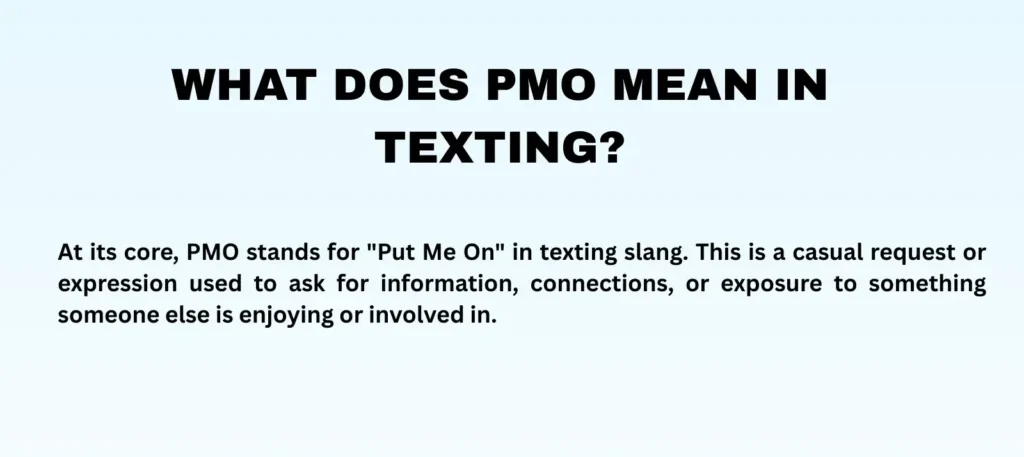
Distinguishing anger from curiosity comes down to sentence mechanics. Because informal digital communication frequently drops capitalization and periods, surrounding prepositions carry the weight of meaning.
Consider three verified communication patterns drawn from standard chat logs:
Scenario 1: Frustration on iMessage
"The professor just moved the exam up to Monday morning, that pmo so bad."
In this exchange, the acronym functions as a verb phrase denoting irritation. The subject ("the professor") causes distress, and the modifier ("so bad") confirms negative sentiment. Replacing the acronym with "put me on" produces nonsense.
Scenario 2: Discovery on TikTok Comments
"Need someone to pmo to this playlist right now."
Here, the preposition "to" acts as the structural giveaway. When followed by "to" and a direct object (a playlist, a brand, a podcast), the term exclusively means "put me on." The user seeks access to a cultural artifact.
Scenario 3: Reactive Disapproval on Group Chats
"Bro did what?? Nah he pmo."
Placed directly after a third-person pronoun, the acronym indicates that a third party's actions produced anger. The tone is reactive, dismissive, and confrontational.
Punctuation alters tone instantly. A trailing question mark ("PMO?") generally leans toward a discovery request, while an all-caps declaration accompanied by an eye-roll emoji ("THAT PMO 🙄") signals peak irritation.
Sarah Jenkins is a veteran tech journalist with over 12 years of experience covering artificial intelligence, mobile innovations, and digital ethics. Her insights have appeared in leading technology publications worldwide.
