How to Turn Your Name into Aesthetic Symbols: the Complete User Guide
 By Sophia Al-Mansoor
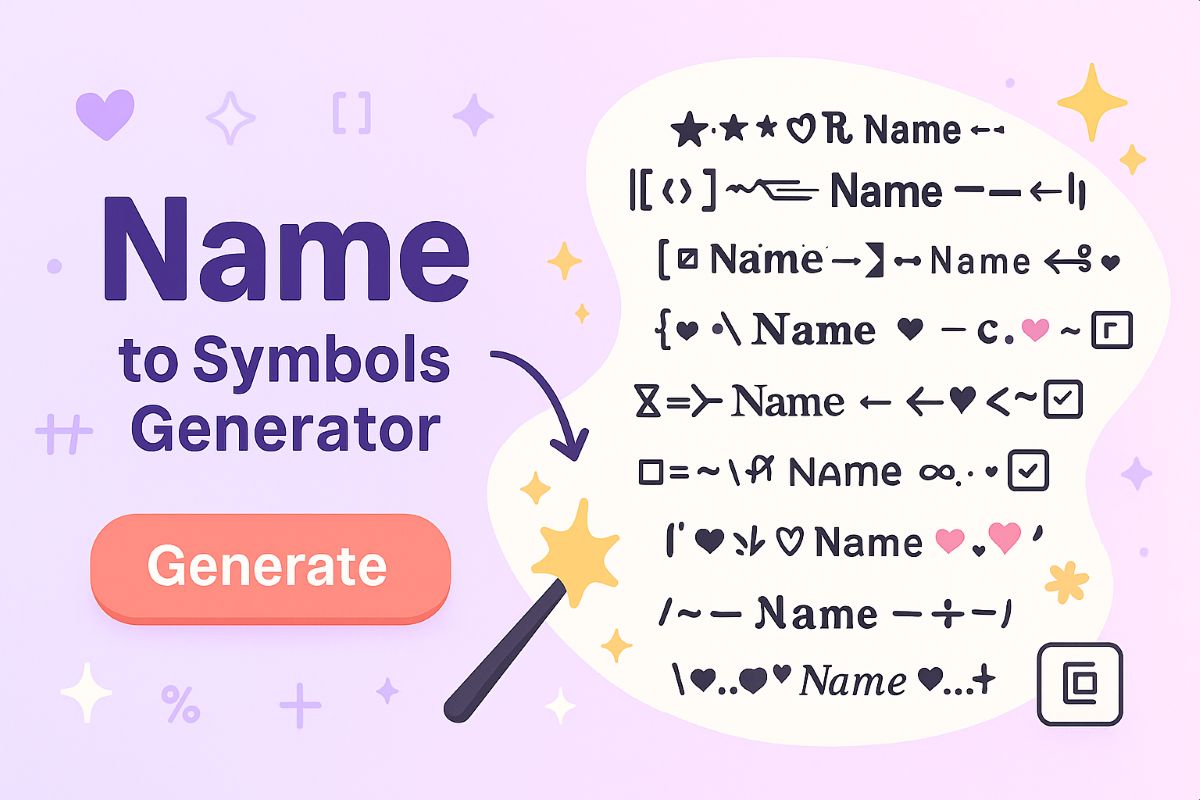
Most internet users assume that changing the look of their username requires installing custom font files like TrueType or OpenType formats. Web input fields on social networks and game clients, however, outright reject external font uploads for security reasons. Instead, platforms evaluate text through universal character encodings, almost universally UTF-8. Every character you type corresponds to a designated hex code point managed by the Unicode Consortium.
A web-based aesthetic text generator takes advantage of this standardized architecture. When you enter a name like "Alex", the script executes an algorithmic translation table. Rather than rendering ASCII code point U+0041 for the capital letter "A", the engine substitutes code point U+1D400 (Mathematical Bold Capital A), U+1D4D0 (Mathematical Bold Script Capital A), or U+1D504 (Mathematical Fraktur Capital A). To your operating system, these are not styled variations of the English alphabet. They are distinct, isolated typographic glyphs created originally for academic formulas, legal documentation, and international linguistic transcription.
This technical distinction explains why fancy font copy and paste workflows work seamlessly across completely different operating systems. If you copy a string of gothic or cursive glyphs from a desktop browser and paste it into mobile messaging apps, the text remains stylized on the recipient's phone. The receiving device is not reading style data or CSS; its local system fonts simply retrieve the specific visual representations assigned to those precise Unicode coordinates.
Sophia analyzes international trade, startup ecosystems, retail transformation, and supply chain logistics for modern digital publications.
