Your or You're? the Complete Cheat Sheet, Mnemonics, and Practice Quiz
 By James H. Sterling
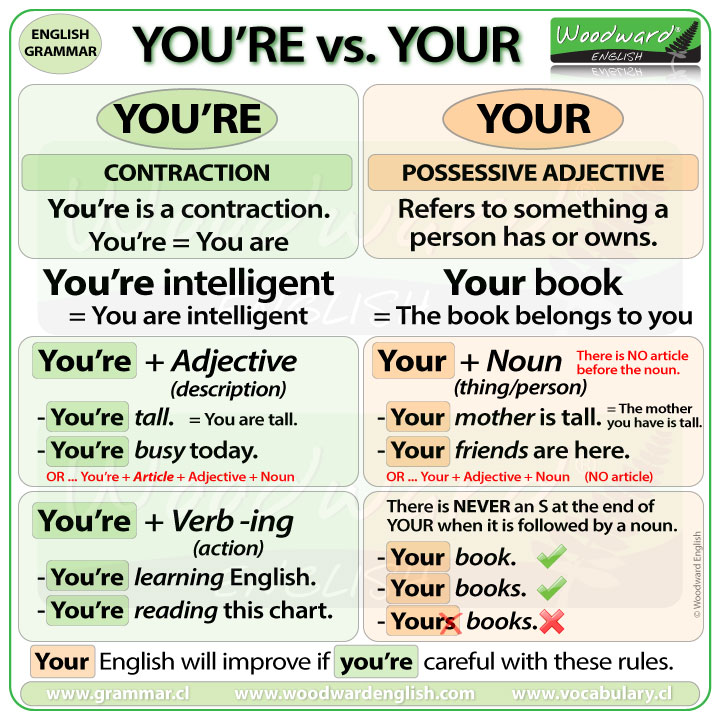
The word your is classified as a possessive adjective (often categorized alongside possessive pronouns, though it technically functions as a determiner modifying nouns). It attributes ownership, association, or affiliation to the person being addressed. Whenever an object, concept, duty, or bodily state belongs to the subject, "your" is the only correct form. Examples include "your desk," "your perspective," and "your schedule." The word never accepts an apostrophe. English punctuation reserves apostrophes in personal pronouns for missing letters, which is why forms like "it's" differ fundamentally from "its," just as "you're" differs from "your."
In contrast, you’re is a direct contraction, a two-word combination functioning as a you are abbreviation. The apostrophe serves a specific mechanical purpose: it marks the omission of the letter "a" when fusing the second-person personal pronoun "you" with the present-tense auxiliary verb "are." Because "you're" contains an active finite verb, it cannot serve as a modifier for another noun without a linking participle or complement. Understanding this syntactical requirement prevents common spelling mistakes before fingers hit the keyboard.
James Sterling reports on renewable energy developments, climate policy, ecological conservation, and green tech innovations around the globe.
