Why the Square Root of 7 Can Never Be Written as a Fraction
 By David Miller
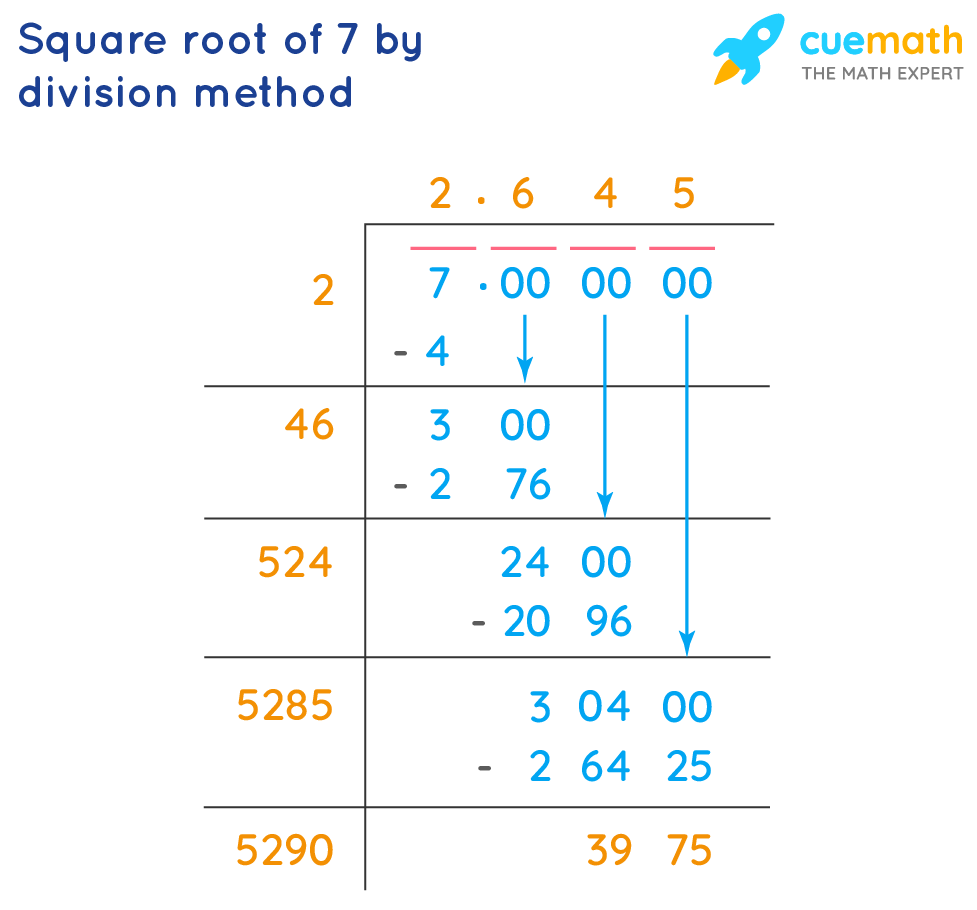
Decimals struggle to describe √7 cleanly because base-10 notation is poorly suited to irrational radicals. Continued fractions offer a far more elegant perspective. By writing a number as an integer plus the reciprocal of another value, quadratic irrationals reveal a hidden periodic structure.
When you expand √7 into a continued fraction, an extraordinary rhythm emerges:
√7 = 2 + 1 / (1 + 1 / (1 + 1 / (1 + 1 / (4 + ...))))
In standard compact notation, this is written as [2; 1, 1, 1, 4], where the bar indicates that the sequence 1, 1, 1, 4 repeats indefinitely. The initial integer is 2, followed by a four-step cycle that loops forever. This property holds true for all square roots of non-square integers, a consequence of Lagrange's theorem on continued fractions.
Truncating this continued fraction at various points produces rational convergents that yield the best possible fractional approximations for their denominator size. The early convergents include 2/1, 3/1, 5/2, 8/3, and 37/14. The fraction 8/3 gives 2.666..., while 37/14 yields approximately 2.6428. These convergents are directly tied to solutions of Pell's equation (x² - 7y² = 1), where the integer pair (8, 3) satisfies 8² - 7(3²) = 64 - 63 = 1.
David Miller brings 15 years of experience in global economics, personal finance strategy, and market dynamics. He specializes in turning complex economic trends into actionable insights for everyday readers.
