Why Mixing Red and Green Doesn't Make What You Think: the Optical Science Mystery
 By Sarah Jenkins
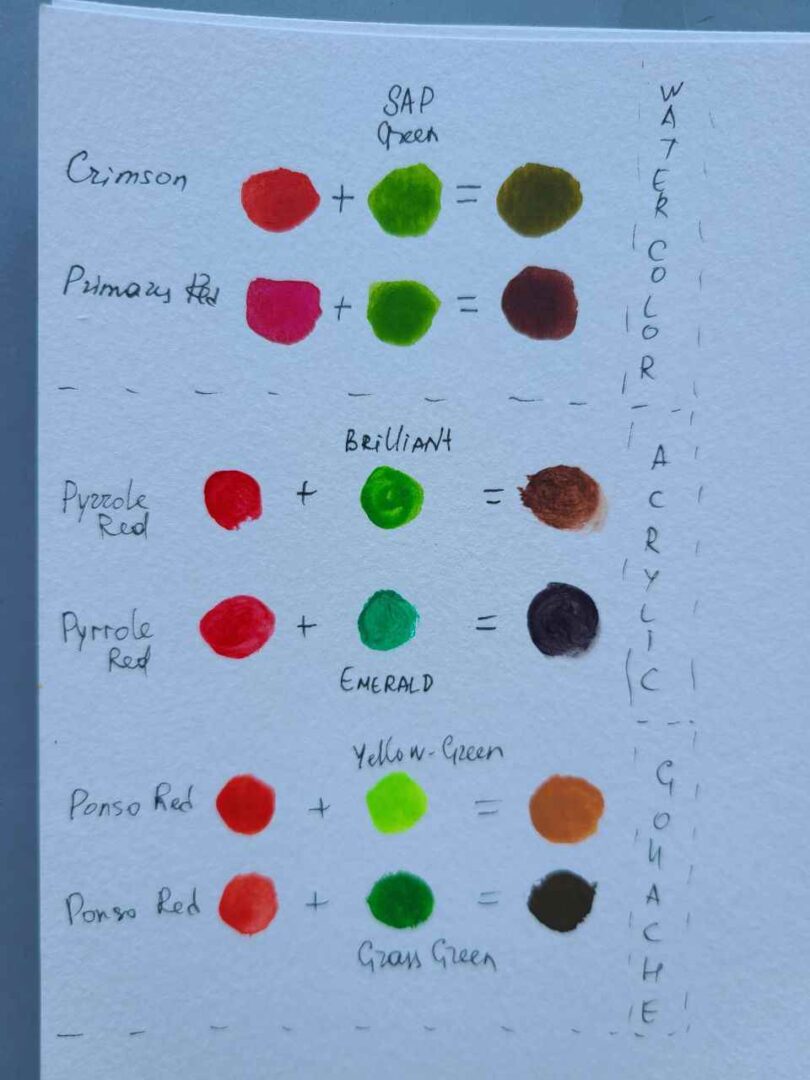
Q1: Can you ever mix red and green paint to make yellow?
No. In subtractive color theory, mixing physical pigments always subtracts light. Because red paint absorbs green wavelengths and green paint absorbs red wavelengths, blending them pulls reflectivity out of the visible spectrum, inevitably producing dull browns, drabs, or dark grays.
Q2: Why does red and green light look yellow instead of white?
White light requires balanced stimulation across all three retinal receptor groups: S-cones (blue), M-cones (green), and L-cones (red). Combining only red and green stimulates the M and L cones while leaving the S-cones inactive, which the visual cortex registers as yellow.
Q3: Why do some red and green paint mixes look olive instead of brown?
Many commercial paints contain chemical impurities and secondary pigment binders. If the green paint leans toward yellow (such as a phthalo green yellow-shade) and the red paint is a diluted warm scarlet, the small reflective pocket between 550 and 580 nanometers can survive absorption, yielding an earthy olive tint.
Sarah Jenkins is a veteran tech journalist with over 12 years of experience covering artificial intelligence, mobile innovations, and digital ethics. Her insights have appeared in leading technology publications worldwide.
