What Is Mouse Polling Rate? the Complete Guide to Hz, Latency, and Settings
 By Marcus Vance
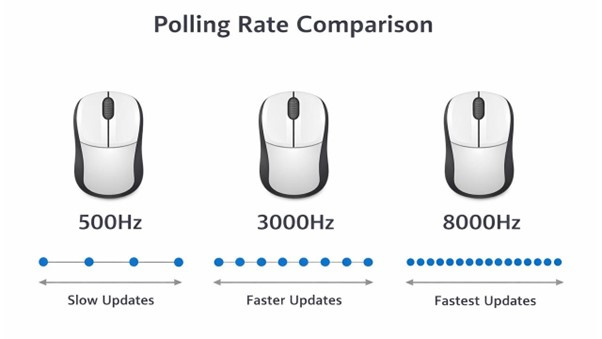
Polling rate, often labeled as report rate, refers to the frequency with which a mouse controller communicates sensor position, click packets, and scroll data across the USB bus or wireless receiver. The value is expressed in Hertz (Hz). A standard office mouse operating at 125Hz communicates once every 8 milliseconds (ms). A mainstream gaming pointer set to 1,000Hz reports every 1ms.
When you swing your crosshair across a tactical shooter map, your computer does not see continuous real-time movement. It receives individual coordinate snapshots. The formula governing report latency is straightforward:
Latency (in milliseconds) = 1,000 / Polling Rate (in Hz)
At 125Hz, positional data can be delayed by up to 8ms before your PC receives the update. At 500Hz, that delay drops to 2ms. At 1,000Hz, communication delay shrinks to 1ms. Modern hyper-polling peripherals operating at 4,000Hz and 8,000Hz compress those transmission windows down to 0.25ms and 0.125ms respectively.
This transmission interval does not eliminate sensor processing delay or pixel transition times on your screen. It simply minimizes the idle window during which fresh tracking data sits queued in the mouse buffer waiting for an operating system request.
Marcus Vance is a cybersecurity auditor and technology writer dedicated to educating the public about online safety, data privacy regulations, enterprise security, and emerging cyber threats.
