San Diego Bioluminescence Tracker: Live Sightings, Timing, and Crowds
 By Elena Rostova
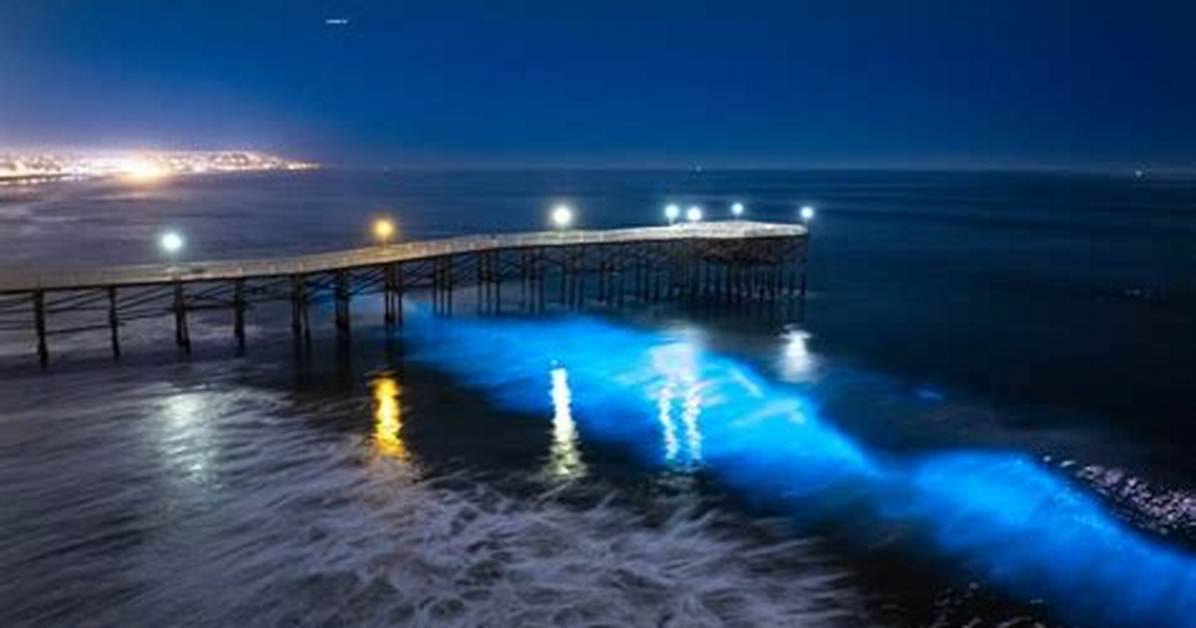
The luminous surf visible from local piers is fundamentally a chemical defense mechanism. Each single-celled Lingulodinium polyedra carries luciferin substrate and luciferase enzyme packed into tiny organelles called scintillons. When turbulent breaking waves deform the cell wall, an influx of protons drops the internal pH, triggering a rapid chemical flash lasting barely 100 milliseconds. Multiplied across trillions of cells concentrated along the surf zone, that microscopic reaction illuminates entire wave faces.
By day, those same concentrations tint the water an earthy reddish-brown, creating the familiar red tide. For decades, the sudden boom-and-bust cycle of these blooms left coastal observers baffled. Research from the Scripps Institution of Oceanography reveals that bloom dynamics depend heavily on plankton predators. Specialized single-celled grazers act as voracious consumers, multiplying rapidly alongside the dinoflagellates and consuming vast swaths of the population within days. A bloom can look vibrant on a Tuesday afternoon and vanish by Thursday evening once these microscopic predators decimate the local biomass.
Nutrient run-off, steady sunlight, and a stratified water column kick-start the accumulation. When surface layers heat up and winds drop, L. polyedra swims upward toward sunlight during daylight hours, gathering in dense mats along the surface. Come nightfall, they descend slightly, hovering right where swell energy trips over sandbars and reefs.
Elena Rostova holds a Master's degree in Public Health Journalism. She covers groundbreaking medical research, holistic wellness trends, mental health awareness, and nutritional science.
