From 1789 Discovery to Modern Nuclear Accords: What Is Uranium's True Impact?
 By Marcus Vance
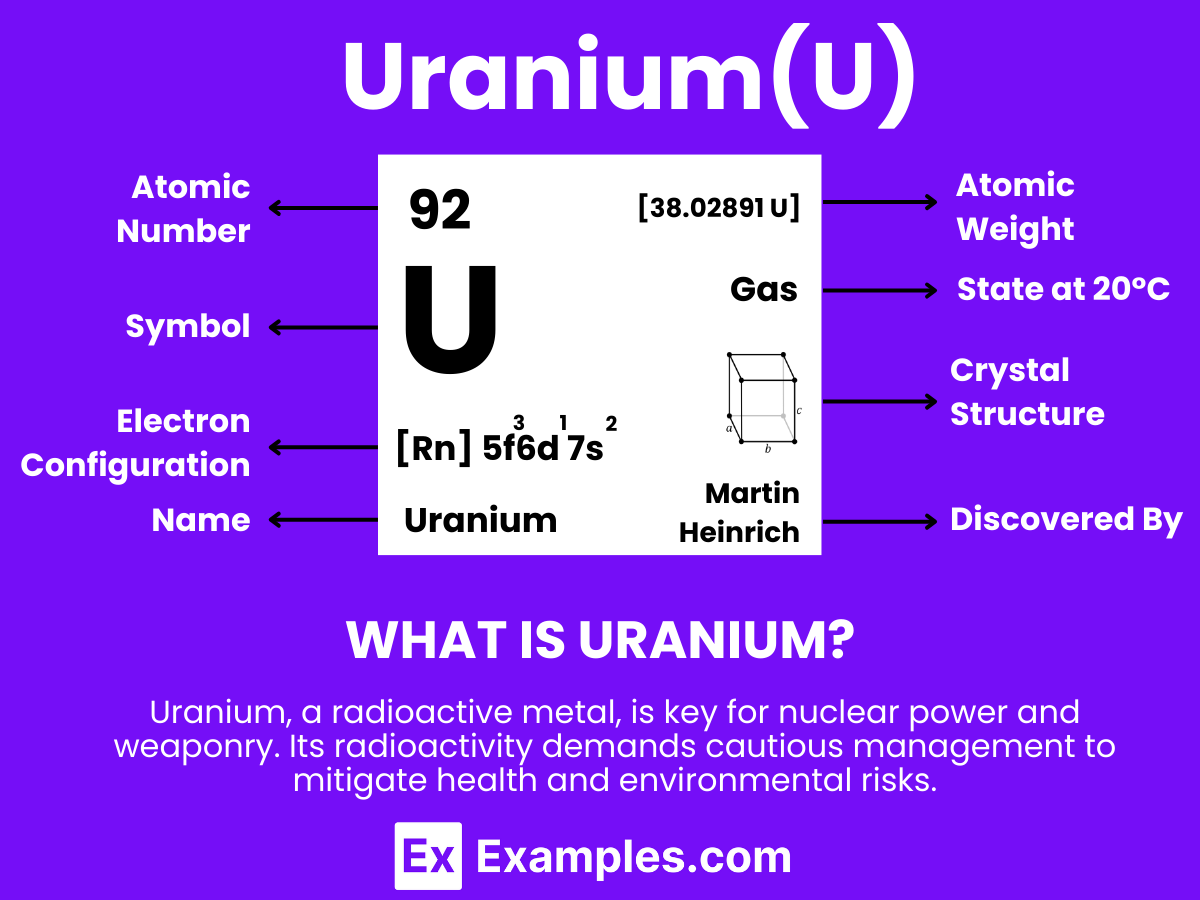
Uranium is the heaviest naturally occurring element found in meaningful abundance. In its natural metallic state, it is silvery-gray, malleable, and roughly 70% denser than lead. A single cubic foot weighs well over 1,000 pounds. Yet its physical bulk matters far less than the balance of protons and neutrons inside its nucleus.
Natural deposits consist almost entirely of two distinct isotopes: non-fissile uranium-238 (which makes up roughly 99.27% of all mined ore) and the fragile U-235 isotope (accounting for roughly 0.72%). When a stray, low-energy thermal neutron strikes the nucleus of an atom of U-235, the nucleus absorbs it, turns momentarily unstable, and fractures violently. This event is nuclear fission.
Splitting that single nucleus releases two or three additional free neutrons alongside a burst of kinetic energy and gamma radiation. If adjacent U-235 atoms absorb those newly liberated neutrons, the process repeats, sustaining a controlled chain reaction. In commercial power stations, surrounding coolant absorbs the resulting kinetic heat, producing pressurized steam that spins heavy electricity turbines. Because nuclear binding forces are millions of times stronger than chemical bonds, a uranium ceramic fuel pellet roughly the size of a fingertip yields the energy equivalent of nearly one ton of thermal coal or three barrels of crude oil.
Marcus Vance is a cybersecurity auditor and technology writer dedicated to educating the public about online safety, data privacy regulations, enterprise security, and emerging cyber threats.
