Complete Bilingual Guide: How to Translate and Buy Shock Absorbers in English
 By Robert Thorne
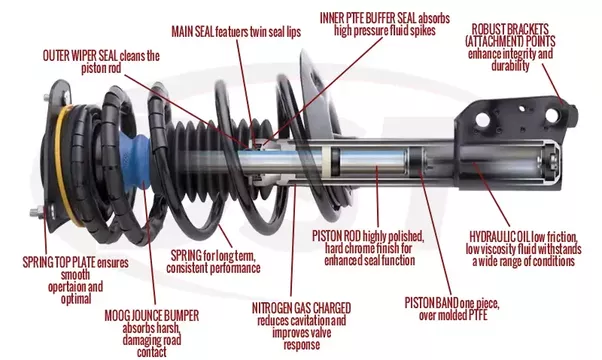
When ordering front suspension components from US parts warehouses, you face an immediate choice: buying a "bare strut" or a "complete loaded strut."
A bare strut is simply the metal damper unit itself. Opting for bare struts saves money on parts invoices, a bare unit often runs $45, $95, while a complete loaded assembly ranges from $110, $240.
However, installing a bare strut requires removing the old assembly, mounting it inside a manual spring compressor tool, compressing the high-tension coil spring, removing the top nut, and transferring the old coil spring, rubber insulators, and worn bearing plate onto the new strut cartridge.
Spring compressors pose real physical danger if handled incorrectly; an unseated coil releasing under pressure carries enough kinetic force to cause catastrophic injury. Furthermore, reused top mounts and spring seats often fail within 10,000, 15,000 miles of the repair, producing knocking noises over bumps and forcing owners to pay for labor a second time.
For home mechanics and budget-conscious DIYers, the industry standard choice is the loaded strut, frequently marketed under brand trademarks like Monroe Quick-Struts, Gabriel ReadyMounts, or KYB Strut-Plus. These units arrive factory-assembled with calibrated coil springs, fresh rubber isolators, and brand-new upper mounts. You unbolt the three strut tower nuts in the engine bay, unbolt the lower knuckle bolts, swap the entire unit, and bolt it back together in half the time without touching a dangerous spring compression tool.
Robert Thorne covers electric vehicle innovations, autonomous driving systems, global mobility trends, and automotive engineering developments.
